Most Christians do not observe the Feasts of the Lord because they believe that these feasts were for the Jews only and it became unnecessary to observe them after Jesus died on the cross. They argue that the Feasts of the Lord were part of the Ceremonial Law that ended with His crucifixion. They say the Feasts of the Lord were “Nailed to the Cross.” What are the arguments that they make to support this idea? Let’s examine these arguments.
- There were special animal sacrifices associated with the Feasts of the Lord. When Jesus was Crucified, it was no longer necessary to make these sacrifices. Therefore, it was no longer necessary to observe the day. It is true that animal sacrifices were no longer necessary when Jesus was crucified. Daniel 9: 27 (KJV) says, “And he shall confirm the covenant with many for one week: and in the midst of the week he shall cause the sacrifice and the oblation to cease.” Sacrifices did continue after Christ’s death until the Temple was destroyed almost 40 years later. However, His death on the cross made these sacrifices no longer necessary. The animals that were sacrificed pointed to His great sacrifice. This is explained in Hebrews 10:
4 For it is not possible that the blood of bulls and of goats should take away sins… 11 And every priest standeth daily ministering and offering oftentimes the same sacrifices, which can never take away sins: 12 But this man, after he had offered one sacrifice for sins for ever, sat down on the right hand of God;
Hebrews 10: 4, 11-12 (KJV)
Only the blood of Jesus could pay the ransom that sin required. The sacrifice of the animals was prophetic of this “sacrifice for sins for ever.” Once this happened, what would be the purpose of sacrificing the animals? It is easy to see how Christ who the animal sacrifices pointed to made these sacrifices no longer necessary. However, does this mean that observing the day is no longer necessary. During the Feast of Tabernacles 70 lambs were sacrificed during the 7 days of the Feast. Since we are no longer required to sacrifice these lambs, do we also not need to observe the days of the feast? Were the Feasts of the Lord nothing more than a sacrifice?
There were special sacrifices that were to be made on the Sabbath.
9 And on the sabbath day two lambs of the first year without spot, and two tenth deals of flour for a meat offering, mingled with oil, and the drink offering thereof: 10 This is the burnt offering of every sabbath, beside the continual burnt offering, and his drink offering
Numbers 28: 9, 10 (KJV)
Sunday observing Christians say that just as it was no longer necessary to sacrifice these two lambs on the Sabbath it was no longer necessary to observe the Sabbath. The Sabbath, they say, was nailed to the cross. Seventh Day Adventists say that after the crucifixion of Christ it was no longer necessary to sacrifice these two lambs but the Sabbath day itself was not nailed to the cross. However, they say that not only were the sacrifices of the animals on Feast days nailed to the cross, the Feast days themselves were nailed to the cross and it was no longer necessary to observe them. They argue that when the Sabbath day was created, the earth was perfect and there were no animal sacrifices at that time. On the other hand, they argue that the Feasts of the Lord were not instituted until 2500 years after sin entered the earth and therefore, the Feasts of the Lord were nailed to the cross with the sacrifices.
Is it true that the Feasts of the Lord were not instituted until 2500 years after sin entered the earth? It is true that there is no specific mention of the observance of the Feasts of the Lord in the book of Genesis. However, there is also no specific mention of the observance of the Sabbath in the book of Genesis after its mention in Genesis 2: 2, 3. But it is not logical that the Sabbath would be a day of creation that is blessed and sanctified by God and then not observed until the Ten Commandments were given at Mt. Sinai. There is very strong circumstantial evidence that the Sabbath was observed in the book of Genesis. It is found in the story of Isaac after he married Rebekah. There was a famine in the land of Canaan and Isaac was debating whether or not to go to Egypt. God spoke to Isaac and told him not to go to Egypt:
3 Sojourn in this land, and I will be with thee, and will bless thee; for unto thee, and unto thy seed, I will give all these countries, and I will perform the oath which I sware unto Abraham thy father; 4 And I will make thy seed to multiply as the stars of heaven, and will give unto thy seed all these countries; and in thy seed shall all the nations of the earth be blessed; 5 Because that Abraham obeyed my voice, and kept my charge, my commandments, my statutes, and my laws.
Genesis 26: 3 – 5 (KJV)
It says that Abraham kept God’s “commandments” and “laws.” In the context of the books of Moses, it only makes sense that this would have included the Ten Commandments. It only makes sense that Abraham kept the Sabbath day holy.
We can use this same argument to say that Abraham observed times appointed by God. In other words, Abraham kept Feasts of the Lord. Just as the Sabbath was mentioned in the account of the week of Creation, so were the Feasts of the Lord. We see this on the fourth day of Creation:
14 And God said, Let there be lights in the firmament of the heaven to divide the day from the night; and let them be for signs, and for seasons, and for days, and years:
Genesis 1: 14 (KJV)
The word for “seasons” in this verse is the Hebrew word מוֹעֵד (Strong’s H4150 – môʿēḏ). This word is the same word translated as “feasts” in “Feasts of the Lord.” This same word appears in Psalms 104: 19 which says, “19 He appointed the moon for seasons: the sun knoweth his going down.” Just as it makes no sense that God would create the Sabbath and then not have anyone observe it for 2500 years, it also makes no sense that God would create the moon for the purpose of determining His appointed times and then not have any appointed times for 2500 years.
In the story of Isaac, I think we can also argue that Abraham kept times appointed by God. In the text in Genesis 26 quoted above God says that Abraham kept “my statutes.” The word for “statutes” in this verse is the Hebrew word חֻקָּה (Strong’s H2708 – ḥuqqâ). This word is used at least 18 times in the Old Testament in the context of the Feasts of the Lord. I can make just as strong of a case that Abraham observed Feasts of the Lord as I can that Abraham observed the Sabbath. Can I say that Abraham observed Passover or the Feast of Tabernacles? No, I cannot. However, Abraham lived in the land of Canaan. He would have been able to determine when the barley ripened. He would have been able to observe the new moons. He could have observed the Feasts of the Lord just as they were delineated in Leviticus 23.
When we say that the Feasts of the Lord were nailed to the cross because the sacrifices on those days were nailed to the cross we are in effect saying that the Feasts of the Lord were nothing more that days on which we could kill a few more animals. The Feasts of the Lord were much more than that. It is true that there was an agricultural aspect to the Feasts. Even though most of us are not farmers there is still a lesson from this aspect of the Feasts: If we trust in God completely and obey His commands, He will give us everything we need. There is also a memorial aspect to the Feasts. These are tied to the deliverance of the Hebrews from their slavery in Egypt. However, this is a metaphor for our slavery to sin. Just as God delivered the Hebrews from their slavery to the Egyptians and led them to the promised land, He wants to deliver us from our slavery to sin and lead us to the promised land. Most importantly, there is a prophetic aspect to the Feasts of the Lord. The Feasts of the Lord are prophetic of the plan of salvation. They are prophetic of both the First Advent and the Second Advent. This means they are prophetic of events that have not happened yet. Furthermore, they are not only prophetic of what will happen but when it will happen. By observing the Feasts of the we can be looking back as a memorial to the events in the plan of salvation that have already been fulfilled and looking forward to the events yet to be fulfilled. Nobody says that the Sabbath is any less of a blessing now than it was when we were sacrificing 2 lambs on that day. Why should we say that there is no blessing to be obtained from observing the Feasts of the Lord now that we are no longer sacrificing animals?
There is an expression, “Don’t throw out the baby with the bathwater.” This means that we should not discard something that is important when we are discarding something that is no longer important. When we discard the Feasts of the Lord with the sacrifices that were rendered no longer necessary by Christ’s death on the cross, we are throwing out the baby with the bathwater. When people don’t observe the Sabbath, they are failing to gain the blessings God has promised them by observing the Sabbath. The same is true of the Feasts of the Lord. When we don’t observe the Feasts of the Lord we are not acknowledging that we rely upon God to give us everything we need. We are not looking back to how God has led us in the past. We are not looking forward to where He will lead us in the future. Because the Feasts of the Lord are prophetic not only of what will happen but when it will happen, when we observe the Feasts, we will be better able to distinguish God’s fulfilment of these events from Satan’s counterfeit of these events. Remember, Jesus Himself said, “24 For there shall arise false Christs, and false prophets, and shall shew great signs and wonders; insomuch that, if it were possible, they shall deceive the very elect” Matthew 24: 24 (KJV). Satan is the most advanced being ever created by God. Don’t think that, apart from Jesus, you are any match for Satan. God gave us the Feasts of the Lord to help us to recognize the milestones in the plan of salvation. We should not cast these aside because we no longer need to sacrifice animals. The Feast Days may be how we avoid being deceived by Satan’s counterfeit.
After examining this issue, I think that the argument that because animal sacrifices were nailed to the cross the Feasts of the Lord were also nailed to the cross is an invalid argument. If we are not supposed to continue to observe the Feasts of the Lord, then we should look for another argument. In the next article, I will examine the argument that we should no longer observe the Feasts of the Lord because the Temple was destroyed.
_____________________________________________________________________________________________________
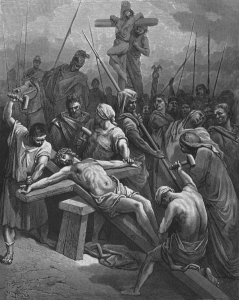
Image: Jesus Nailed to the Cross by Gustave Dore (1832-1883) is in the Public Domain. This image was taken from The Accordance Gallery of Bible Art, edited by David Lang.


 imunify-bot-check
Posted: July 6, 2025 · Leave a Comment
Arguments Against Observing the Feasts of the Lord: 1. Nailed to the Cross.
Most Christians do not observe the Feasts of the Lord because they believe that these feasts were for the Jews only and it became unnecessary to observe them after Jesus died on the cross. They argue that the Feasts of the Lord were part of the Ceremonial Law that ended with His crucifixion. They say the Feasts of the Lord were “Nailed to the Cross.” What are the arguments that they make to support this idea? Let’s examine these arguments.
4 For it is not possible that the blood of bulls and of goats should take away sins… 11 And every priest standeth daily ministering and offering oftentimes the same sacrifices, which can never take away sins: 12 But this man, after he had offered one sacrifice for sins for ever, sat down on the right hand of God;
Hebrews 10: 4, 11-12 (KJV)
Only the blood of Jesus could pay the ransom that sin required. The sacrifice of the animals was prophetic of this “sacrifice for sins for ever.” Once this happened, what would be the purpose of sacrificing the animals? It is easy to see how Christ who the animal sacrifices pointed to made these sacrifices no longer necessary. However, does this mean that observing the day is no longer necessary. During the Feast of Tabernacles 70 lambs were sacrificed during the 7 days of the Feast. Since we are no longer required to sacrifice these lambs, do we also not need to observe the days of the feast? Were the Feasts of the Lord nothing more than a sacrifice?
There were special sacrifices that were to be made on the Sabbath.
9 And on the sabbath day two lambs of the first year without spot, and two tenth deals of flour for a meat offering, mingled with oil, and the drink offering thereof: 10 This is the burnt offering of every sabbath, beside the continual burnt offering, and his drink offering
Numbers 28: 9, 10 (KJV)
Sunday observing Christians say that just as it was no longer necessary to sacrifice these two lambs on the Sabbath it was no longer necessary to observe the Sabbath. The Sabbath, they say, was nailed to the cross. Seventh Day Adventists say that after the crucifixion of Christ it was no longer necessary to sacrifice these two lambs but the Sabbath day itself was not nailed to the cross. However, they say that not only were the sacrifices of the animals on Feast days nailed to the cross, the Feast days themselves were nailed to the cross and it was no longer necessary to observe them. They argue that when the Sabbath day was created, the earth was perfect and there were no animal sacrifices at that time. On the other hand, they argue that the Feasts of the Lord were not instituted until 2500 years after sin entered the earth and therefore, the Feasts of the Lord were nailed to the cross with the sacrifices.
Is it true that the Feasts of the Lord were not instituted until 2500 years after sin entered the earth? It is true that there is no specific mention of the observance of the Feasts of the Lord in the book of Genesis. However, there is also no specific mention of the observance of the Sabbath in the book of Genesis after its mention in Genesis 2: 2, 3. But it is not logical that the Sabbath would be a day of creation that is blessed and sanctified by God and then not observed until the Ten Commandments were given at Mt. Sinai. There is very strong circumstantial evidence that the Sabbath was observed in the book of Genesis. It is found in the story of Isaac after he married Rebekah. There was a famine in the land of Canaan and Isaac was debating whether or not to go to Egypt. God spoke to Isaac and told him not to go to Egypt:
3 Sojourn in this land, and I will be with thee, and will bless thee; for unto thee, and unto thy seed, I will give all these countries, and I will perform the oath which I sware unto Abraham thy father; 4 And I will make thy seed to multiply as the stars of heaven, and will give unto thy seed all these countries; and in thy seed shall all the nations of the earth be blessed; 5 Because that Abraham obeyed my voice, and kept my charge, my commandments, my statutes, and my laws.
Genesis 26: 3 – 5 (KJV)
It says that Abraham kept God’s “commandments” and “laws.” In the context of the books of Moses, it only makes sense that this would have included the Ten Commandments. It only makes sense that Abraham kept the Sabbath day holy.
We can use this same argument to say that Abraham observed times appointed by God. In other words, Abraham kept Feasts of the Lord. Just as the Sabbath was mentioned in the account of the week of Creation, so were the Feasts of the Lord. We see this on the fourth day of Creation:
14 And God said, Let there be lights in the firmament of the heaven to divide the day from the night; and let them be for signs, and for seasons, and for days, and years:
Genesis 1: 14 (KJV)
The word for “seasons” in this verse is the Hebrew word מוֹעֵד (Strong’s H4150 – môʿēḏ). This word is the same word translated as “feasts” in “Feasts of the Lord.” This same word appears in Psalms 104: 19 which says, “19 He appointed the moon for seasons: the sun knoweth his going down.” Just as it makes no sense that God would create the Sabbath and then not have anyone observe it for 2500 years, it also makes no sense that God would create the moon for the purpose of determining His appointed times and then not have any appointed times for 2500 years.
In the story of Isaac, I think we can also argue that Abraham kept times appointed by God. In the text in Genesis 26 quoted above God says that Abraham kept “my statutes.” The word for “statutes” in this verse is the Hebrew word חֻקָּה (Strong’s H2708 – ḥuqqâ). This word is used at least 18 times in the Old Testament in the context of the Feasts of the Lord. I can make just as strong of a case that Abraham observed Feasts of the Lord as I can that Abraham observed the Sabbath. Can I say that Abraham observed Passover or the Feast of Tabernacles? No, I cannot. However, Abraham lived in the land of Canaan. He would have been able to determine when the barley ripened. He would have been able to observe the new moons. He could have observed the Feasts of the Lord just as they were delineated in Leviticus 23.
When we say that the Feasts of the Lord were nailed to the cross because the sacrifices on those days were nailed to the cross we are in effect saying that the Feasts of the Lord were nothing more that days on which we could kill a few more animals. The Feasts of the Lord were much more than that. It is true that there was an agricultural aspect to the Feasts. Even though most of us are not farmers there is still a lesson from this aspect of the Feasts: If we trust in God completely and obey His commands, He will give us everything we need. There is also a memorial aspect to the Feasts. These are tied to the deliverance of the Hebrews from their slavery in Egypt. However, this is a metaphor for our slavery to sin. Just as God delivered the Hebrews from their slavery to the Egyptians and led them to the promised land, He wants to deliver us from our slavery to sin and lead us to the promised land. Most importantly, there is a prophetic aspect to the Feasts of the Lord. The Feasts of the Lord are prophetic of the plan of salvation. They are prophetic of both the First Advent and the Second Advent. This means they are prophetic of events that have not happened yet. Furthermore, they are not only prophetic of what will happen but when it will happen. By observing the Feasts of the we can be looking back as a memorial to the events in the plan of salvation that have already been fulfilled and looking forward to the events yet to be fulfilled. Nobody says that the Sabbath is any less of a blessing now than it was when we were sacrificing 2 lambs on that day. Why should we say that there is no blessing to be obtained from observing the Feasts of the Lord now that we are no longer sacrificing animals?
There is an expression, “Don’t throw out the baby with the bathwater.” This means that we should not discard something that is important when we are discarding something that is no longer important. When we discard the Feasts of the Lord with the sacrifices that were rendered no longer necessary by Christ’s death on the cross, we are throwing out the baby with the bathwater. When people don’t observe the Sabbath, they are failing to gain the blessings God has promised them by observing the Sabbath. The same is true of the Feasts of the Lord. When we don’t observe the Feasts of the Lord we are not acknowledging that we rely upon God to give us everything we need. We are not looking back to how God has led us in the past. We are not looking forward to where He will lead us in the future. Because the Feasts of the Lord are prophetic not only of what will happen but when it will happen, when we observe the Feasts, we will be better able to distinguish God’s fulfilment of these events from Satan’s counterfeit of these events. Remember, Jesus Himself said, “24 For there shall arise false Christs, and false prophets, and shall shew great signs and wonders; insomuch that, if it were possible, they shall deceive the very elect” Matthew 24: 24 (KJV). Satan is the most advanced being ever created by God. Don’t think that, apart from Jesus, you are any match for Satan. God gave us the Feasts of the Lord to help us to recognize the milestones in the plan of salvation. We should not cast these aside because we no longer need to sacrifice animals. The Feast Days may be how we avoid being deceived by Satan’s counterfeit.
After examining this issue, I think that the argument that because animal sacrifices were nailed to the cross the Feasts of the Lord were also nailed to the cross is an invalid argument. If we are not supposed to continue to observe the Feasts of the Lord, then we should look for another argument. In the next article, I will examine the argument that we should no longer observe the Feasts of the Lord because the Temple was destroyed.
_____________________________________________________________________________________________________
Image: Jesus Nailed to the Cross by Gustave Dore (1832-1883) is in the Public Domain. This image was taken from The Accordance Gallery of Bible Art, edited by David Lang.
Categories Blog
Recent Posts
Recent Comments
Archives
Categories